
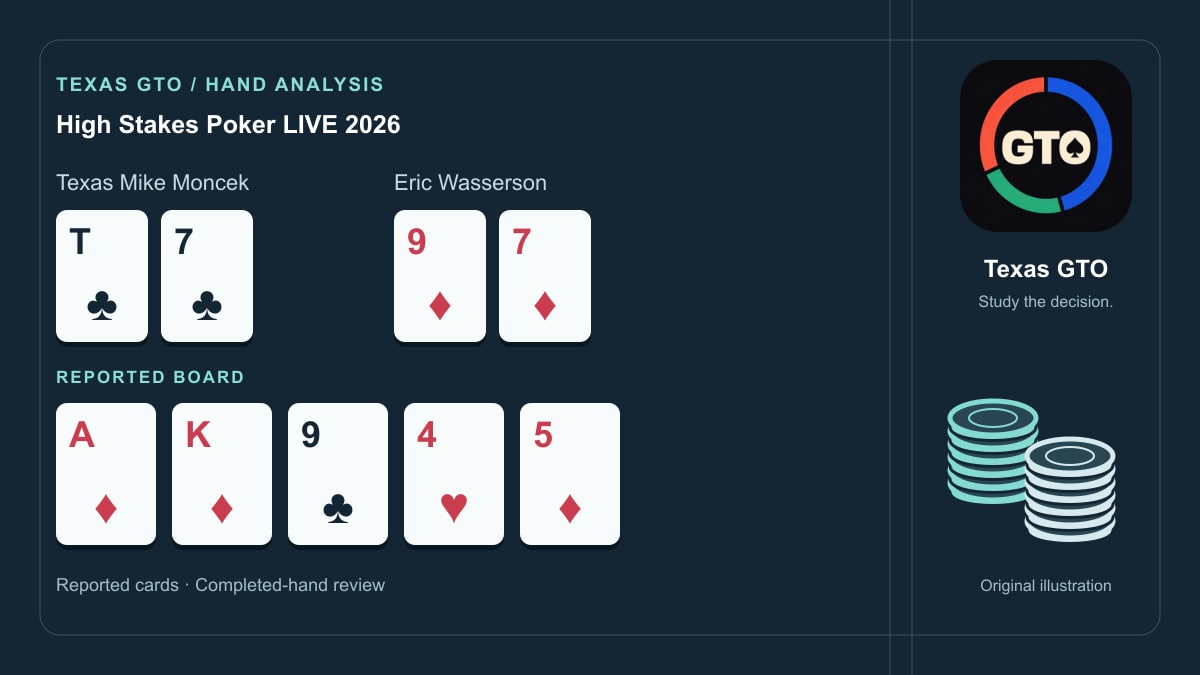
The reported hand: a $4.26 million river decision
REPORTED HAND / VISUAL REPLAY
Ten-high bluff against the 9♦7♦ flush
Community cards
- 01PreflopWasserson opened to $20k; Moncek three-bet to $80k; call.
- 02FlopWasserson checked; Moncek bet $100k; call.
- 03TurnCheck; Moncek bet $330k; call.
- 04RiverCheck; Moncek shoved, covering Wasserson's $1.607M; call. Pot: $4.26M.
PokerGO dates the hand to its August 31 livestream. The suit information matters more than the record: the river adds a third diamond, not a fourth. Wasserson needs both of his hole-card diamonds to make a flush. This is an October study article about that completed hand, not a newly played holiday session.
A made flush is not the same as the nuts
Wasserson's five-card flush is A♦K♦9♦7♦5♦, but the relevant comparison is with Moncek's betting range. Higher two-diamond holdings can beat 9♦7♦. Some non-flush hands might value-bet smaller, but whether they belong in an enormous shove is a separate assumption. If the shove is strongly polarized, this non-nut flush functions mainly as a bluff-catcher. Calling because a flush looks powerful skips the important range question.
Start at preflop and prune hands on each street. Ask which suited hands would three-bet, continue on the ace-king flop and fire the large turn bet. Then ask which of those rivered a flush and which arrive without showdown value. Do not simply assign every possible diamond combination to the river shove; earlier decisions affect how often those combinations get here.
Why the missing diamond matters
T♣7♣ contains no diamond blocker. That leaves the defender's diamond flushes available, unlike a bluff that removes a high diamond. It also removes some club holdings that might have missed and folded. Neither observation alone settles the bluff's quality: card removal has to be tested against an actual continuing range, not treated as a slogan.
The price matters too. For a river call that only wins against bluffs, let P be the pot before the bet and B the amount to call. The required bluff share is B ÷ (P + 2B), before rake. A one-and-a-half-pot bet requires about 37.5%, rather than the 25% required against a half-pot bet. These are teaching examples, not an exact reconstruction of the rounded television graphics.
A three-minute review exercise
Hide the revealed bluff. Build two river ranges: one with frequent missed-draw shoves and one with very few. Compare your decision with 9♦7♦ in each. Next change one hole card to a higher diamond and explain what happens to value combinations and bluff combinations separately. Finally write down what evidence, beyond one spectacular clip, would justify changing your opponent model.
Deep-stacked televised games are not a template for a normal 100-big-blind cash table. Match positions, effective depth and bet sizes before transferring the lesson. The useful habit is evaluating a complete line; the pot's dollar value does not make the decision correct.
Hand review questions
Why can a flush still be a bluff-catcher?
Against a polarized shove that contains only higher flushes and bluffs, a smaller flush beats the bluffs but loses to the value hands. Absolute hand strength and strength against the betting range are different questions.
Does holding no diamond prove the bluff was bad?
No. It means this exact hand removes no diamond flushes from the defender's range. Evaluating the bluff also requires the size, the earlier ranges and the opponent's folding behavior; losing this one pot does not determine its EV.