
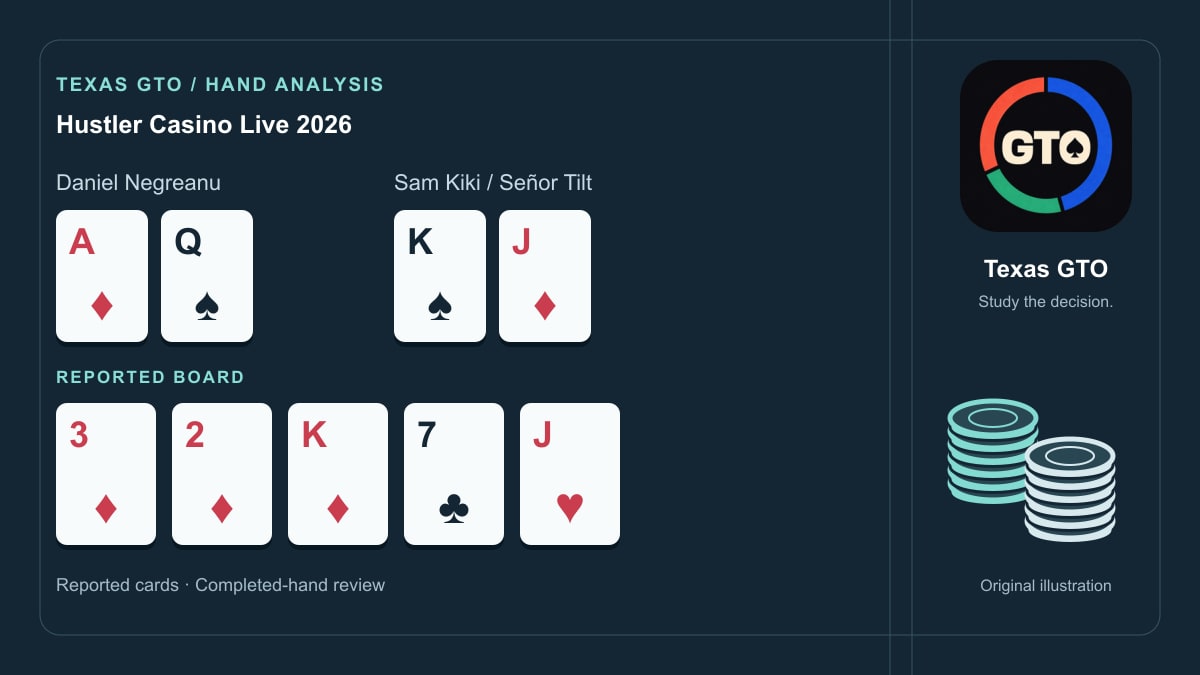
The HCL hand, with the correct turn card
REPORTED HAND / VISUAL REPLAY
Ace-high makes top two pair fold
Community cards
- 01PreflopKiki raised $6k; Negreanu and Dr. H called out of position.
- 02FlopAll three checked the three-diamond flop.
- 03TurnNegreanu bet $6k; Dr. H folded; Kiki called.
- 04RiverNegreanu checked; Kiki bet $20k; raise to $75k; Kiki folded.
This hand comes from Negreanu's August 28 HCL appearance. The original report gives 7♣ on the turn; some secondary summaries substitute 6♣. The replay follows the reported seven. No event photograph or broadcast screenshot is reused here.
Representing the flush without holding it
On a three-diamond flop, a player needs two diamonds in the hole to have a flush. Negreanu's A♦ removes every opponent nut flush containing that card, while A♦Q♠ itself remains ace-high on the river. Those are separate effects: card removal makes some calls impossible, and the earlier action determines whether a flush story is believable.
Checking the flop does not automatically exclude flushes from a multiway range. Strong hands can check, and a turn lead can contain made hands as well as draws. But a credible story requires enough value hands taking this same line. If you bluff every single A♦ hand without constructing the value side, you can still overbluff.
Two pair can be strong and still face a difficult price
Kiki improves to two pair yet faces a raise on a board where flushes were possible from the flop. He must pay $55k more, because his $20k river bet is already committed. Using $75k as the new call amount would overstate his price. Exact pot odds require the actual pot, not a guessed reconstruction of missing forced bets.
His J♦ removes some flushes from the raiser's range. That can favor a call, but the same card may also affect bluff candidates. First build the check-raise range; then test the blocker. A player who almost never check-raise bluffs remains different from a balanced model, even when a defender holds an attractive blocker.
An exercise: the same line, different diamond
Compare A♦Q♠ with Q♦A♠ on the same board. Which strong flush combinations disappear in each case? Which value hands could justify a check-raise, and which missed draws would you select as bluffs? Keep the total bluff count under control rather than promoting every blocker to a mandatory raise.
For a pure bluff, record the total new amount risked and the pot you can win at the decision point. Its break-even fold frequency is risk ÷ (pot + risk), ignoring any chance of winning after a call. This is a review framework, not a claim about the profitability of Negreanu's specific raise or Kiki's fold.
Hand review questions
Why isn't A♦ alone a flush on this board?
Only three diamonds are on the board. A♦Q♠ supplies one more, so Negreanu has four diamonds in total, not the five needed for a flush. The A♦ blocks nut flushes without making one.
Does Kiki's J♦ force a call?
No. It removes some flush combinations but does not settle how often Negreanu bluffs. The call still depends on the additional price and the opponent's check-raising range, not one blocker in isolation.