
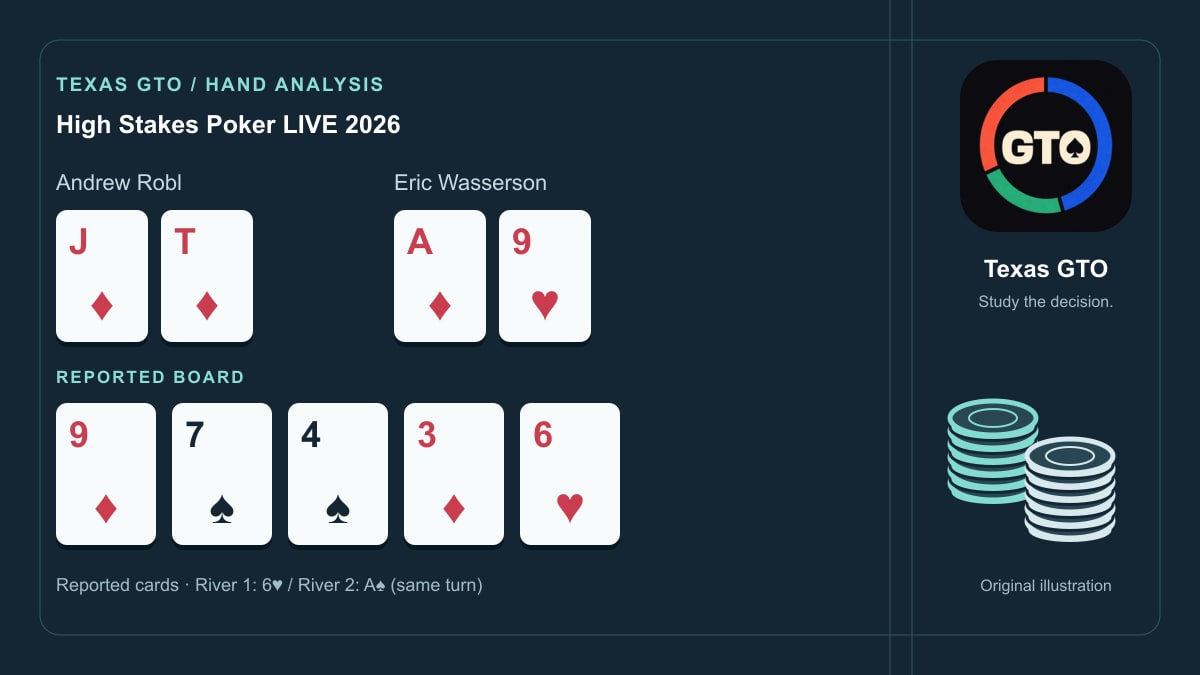
The reported action and the two rivers
REPORTED HAND / VISUAL REPLAY
A draw shoves into top pair
Community cards
Two separate rivers after the same turn; each decides half the pot
- 01PreflopOpen $20k, small-blind call, Robl three-bet $110k; Wasserson four-bet $280k; small blind folded; Robl called.
- 02FlopRobl checked; Wasserson checked back top pair.
- 03TurnRobl checked; Wasserson bet $200k; Robl shoved, leaving about $739k more to call; call.
- 04RiverRiver dealt twice: 6♥, then A♠. Wasserson won both halves; pot $2.478M.
PokerGO confirms this was the August 29 livestream. The pot set a show record at that time, before the August 31 $4.26M hand surpassed it. The visual replay keeps the two river outcomes separate rather than turning them into a fictional six-card board.
A combo draw is an equity cushion, not a verdict
J♦T♦ gains a diamond draw on the turn alongside the gutshot to an eight. Against the actual A♦9♥, jacks and tens can also win by pairing. The ace of diamonds is already in Wasserson's hand, so it cannot be counted as an available diamond out. Cards that improve two different draws must not be counted twice.
That helps explain why the shove is a semi-bluff rather than a pure airball. Robl can win immediately through a fold or improve after a call. But the actual opponent held top pair; against sets, stronger draws or other hands, the useful outs change. A draw's strength must be measured against the range that continues, not only the hand eventually shown.
Fold equity and calling price are separate calculations
A semi-bluff's review has two branches: how often the opponent folds, and the value of the called branch. Adding many outs does not automatically compensate for a huge amount risked. Begin with the pot before the raise, the effective shove amount and the opponent's plausible bet-call range. Do not mix chips already in the pot with fresh chips at risk.
For Wasserson, the decision concerns the additional call, not the headline pot. Using the reported roughly $739k remaining call and $2.478M final pot gives an approximate 29.8% break-even showdown share, before rake and assuming those rounded amounts describe the effective pot. That is a price calculation, not a claim that his hand has that equity against Robl's complete range.
Review the turn before revealing either river
Compare a shoving range rich in draws with one concentrated on strong made hands. Keep the size fixed and ask when A-9 can continue. Then reduce the stack and rebuild the ranges; a deep four-bet pot is not interchangeable with a routine single-raised 100-BB pot.
Finally reveal the two rivers. Neither helped Robl, but the card outcomes are not evidence about his fold equity. Record the pre-river decision separately from the runout. Running twice can soften swings over time; it cannot repair a mistaken range assumption.
Hand review questions
Does running it twice make a losing shove profitable?
No. It splits the pot between two runouts and can reduce variance. It does not create folds after an opponent has called, and the eventual two losses do not establish the shove's original expected value.
Should a player call a huge shove with any top pair?
No. Check the price, effective stack, value hands and semi-bluffs in the opposing range. Top pair may beat draws now while still having substantial losing runouts. The revealed J-T is only one combination, not the entire shoving range.