
The reported $1,517,500 hand
REPORTED HAND / VISUAL REPLAY
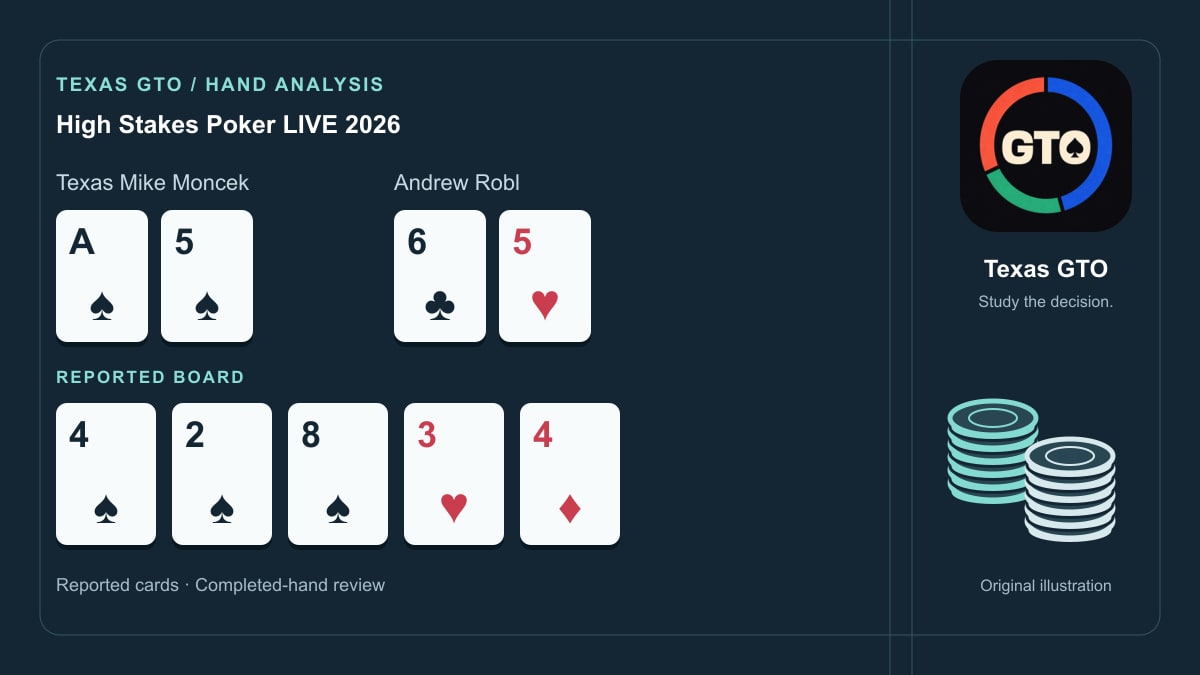
Flopped flush, turned straight, paired river
Community cards
- 01PreflopElamawy raised $40k; Moncek and Robl called. Reported straddles reached $16k.
- 02FlopMoncek bet $55k; Elamawy folded; Robl called.
- 03TurnMoncek bet $150k; Robl called with a straight.
- 04RiverMoncek shoved $490k on the paired board; Robl called. Pot: $1,517,500.
The August 28 High Stakes Poker hand began with straddles as high as $16,000. Both players had more than $700,000 at the start. Those are reported context figures, not a complete blind structure from which we can build an exact preflop chart.
Why strong hands do not always need a slowplay
A♠5♠ has the nut flush on the flop. Betting immediately can extract value from weaker made hands and draws while building a pot before the board becomes more uncomfortable. Slowplaying is not a requirement just because a hand is extremely strong. The best choice depends on how the rest of the betting range is constructed and how opponents respond.
Robl's turn completes a six-high straight, but the three-spade flop means that improvement does not guarantee a winning hand. This is a useful distinction between improving your cards and improving your relative position against the opponent's continuing range. A hand that feels newly powerful can still belong to a vulnerable calling class.
The river pair changes the nuts, not every value bet
The second four permits full houses and quads in the overall hand universe, so the ace-high flush is no longer the absolute nuts. To assess the shove, count plausible boats that reached the river and worse hands likely to pay. Do not count every theoretical full house equally; earlier calls and raises determine which combinations survive.
For Robl, 6♣5♥ contains no spade, so it does not remove the opponent's flush value hands. Yet an aggressive player's bluff frequency still matters. A reputation for big bluffs is a starting hypothesis, not evidence that every river shove is a bluff. Keep this value hand beside Moncek's ten-high bluff rather than drawing conclusions from only the most dramatic clip.
Study value and bluffs together
Build a river shoving range with both flushes and bluffs, then compare the straight against that whole range. Next remove bluff combinations and observe how the decision changes. For the bettor, test a smaller value bet as well: which worse hands would call it but fold to a shove? That question connects size to target hands.
This is qualitative range work, not an approved shove frequency or solver EV. Record missing forced bets and positions instead of filling them in. The transferable lesson is to update hand strength after the board changes and judge an opponent's entire strategy, not a stereotype.
Hand review questions
Does pairing the board mean a flush must stop betting?
No. Full houses become possible, but the decision also depends on how many worse hands can call and how often the opponent holds those boats. A board pair changes the value calculation; it does not automatically ban a bet.
Was Robl's turned straight the nuts?
No. Spade flushes were already possible on the flop. Against the actual A♠5♠, the straight could not win. Before seeing the cards, however, Robl had to evaluate a range, not the revealed flush alone.