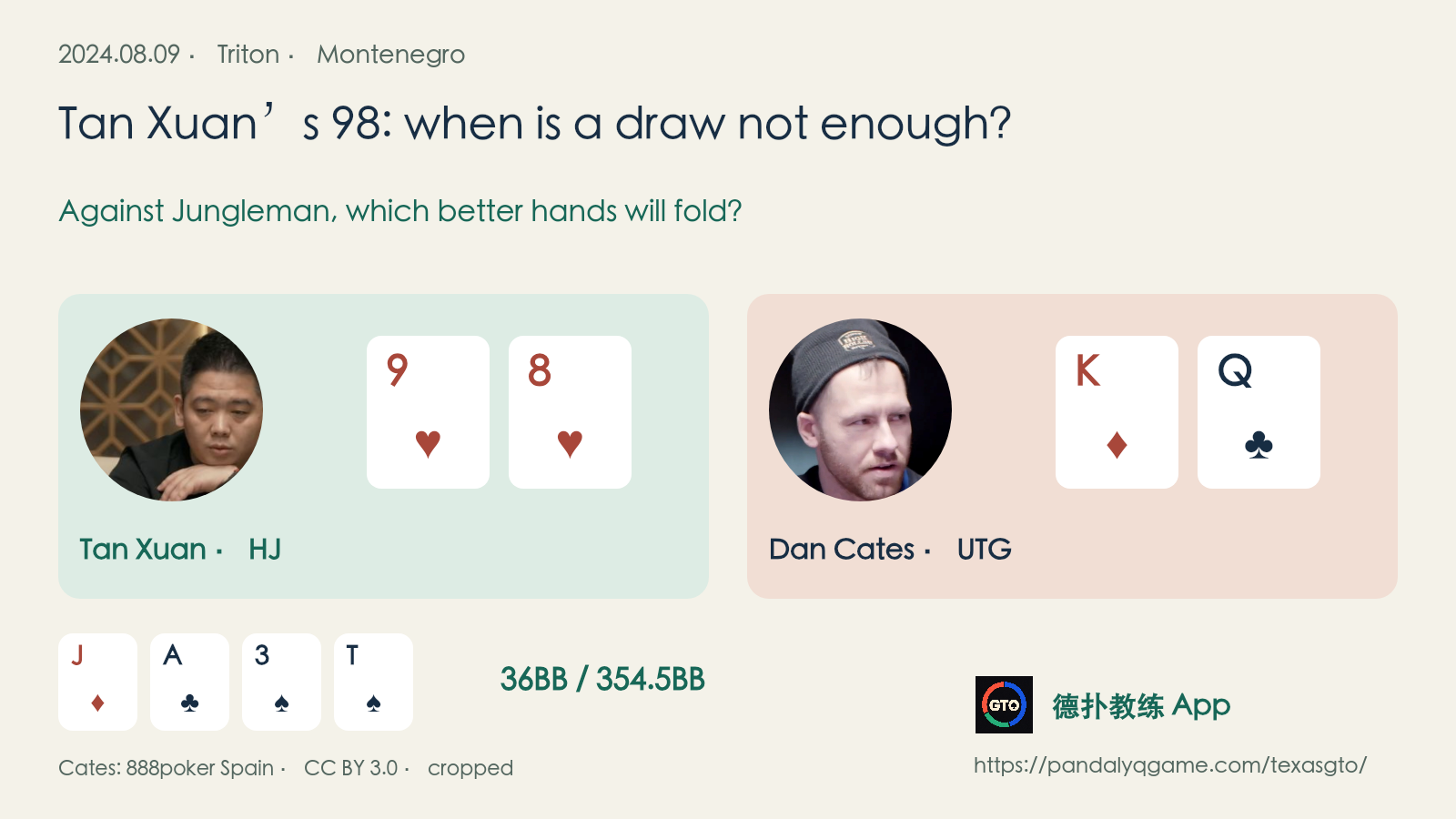
Tan’s portrait uses original pixels from this hand at 02:58:16. Cates photograph: 888poker Spain, CC BY 3.0 via Wikimedia Commons, circular crop. Identification does not imply endorsement. 888poker Spain / Wikimedia Commons · CC BY 3.0

Session and positions
This is a retrospective of the standard 52-card NLHE cash game on Day 6 of Triton Cash Game Invitational I in Montenegro, played and broadcast on 9 August 2024. All amounts below use the original big blind as 1BB: 0.5/1 blinds, 2.5BB big-blind ante and a 2BB UTG straddle. Tan holds 9♥8♥ in the hijack; Cates has K♦Q♣ in the UTG straddle. Starting effective depth is 368BB. Tan covers Cates; his rounded HUD stack is not an exact effective-stack input.
Street-by-street action
REPORTED HAND / VISUAL REPLAY
Tan Xuan 9♥8♥ vs Dan Cates K♦Q♣
Community cards
- 01Preflop | 19BBPaul Phua opens 7♥7♣ to 5BB from UTG+2. Tan calls 5BB in the HJ; Cates adds 3BB to his straddle. The three 5BB contributions plus 4BB in blinds and ante make 19BB.
- 02Flop J♦A♣3♠ | 36BBCates and Phua check. Tan bets 8.5BB, Cates calls and Phua folds. Cates has 354.5BB effective remaining.
- 03Turn T♠ | 356BBCates checks; Tan bets 17.5BB; Cates raises to 62.5BB. Tan reraises to 160BB, adding 142.5BB this time; Cates calls another 97.5BB and retains 194.5BB.
- 04River 6♥ | final pot 745BBCates checks. Tan announces 247.5BB; Cates calls all-in for 194.5BB. The unmatched 53BB is returned. Cates wins with Broadway.
1 | Preflop: position comes with a cost
Calling a suited connector retains Phua’s opening range and uses position against the earlier players, but the HJ still has players behind. A squeeze or a multiway pot remains possible. A reraise can isolate and take initiative, yet 98 lacks high-card blockers and can suffer reverse implied odds against higher straights or flushes. Folding is also a legitimate comparison. No exact preflop mixing frequency is available here.
2 | Flop: two checks do not mean two weak ranges
The 8.5BB bet is 44.74% of the 19BB pot. A stab can fold out weaker holdings and start a credible pressure line, but two opponents make it more likely that someone continues. Ax, sets and KQ can all check; neither range is automatically capped.
98 has no pair and no backdoor heart flush: with zero hearts on the flop, two remaining board cards cannot supply the three hearts it would need. Its improvement relies on backdoor straight routes. Checking is the alternative that avoids immediately investing with little direct equity. Once Cates calls, his range must be filtered rather than left as his entire checking range.
3 | Turn: apparent outs are not range equity
The T♠ gives 98 an open-ended draw: a queen makes a queen-high straight and a seven a jack-high straight. Neither beats KQ’s existing ace-high straight. Eight apparent improving cards are not eight winning outs against every continuing hand.
Betting 17.5BB into 36BB, or 48.61% pot, can pressure some Jx and weaker Ax. Checking behind uses position to control investment and realise some draw equity. Facing the raise to 62.5BB, Tan needs another 45BB; calling creates a 161BB pot, an immediate 27.95% price. Future investment and equity realisation still matter, so that price does not prove a call is profitable.
4 | The reraise to 160BB: identify the target folds
Tan adds 142.5BB, not another 160BB. The stronger value story must persuade some of Cates’s check-raising range to fold. Yet 9♥8♥ removes no KQ combinations and contains no spade; it cannot simply be labelled an excellent blocker bluff.
Cates’s check-raises may contain value and semi-bluffs, but their actual weights are unknown. His extra 97.5BB call produces a 356BB pot, a static 27.39% price. Which better hands fold, and which draws retain a price? Those are the strategic questions, not merely whether Tan is aggressive.
With the nuts, Cates can call to retain river bluffs and weaker hands, or jam to charge strong draws and worse value. The realised bluff on the river does not establish that trapping is always optimal or provide either action’s equilibrium frequency.
5 | River: risk the matched 194.5BB, not the announced 247.5BB
The pot is 356BB. Only 194.5BB of Tan’s announcement can be matched; 53BB returns to him. His effective bet is 54.63% pot. Under a zero-equity-when-called, zero-EV-check and no-additional-rake simplification, a pure bluff needs 194.5/(356+194.5), or 35.33% folds. That is a threshold, not an observed fold rate.
A range that check-raised and then called a turn three-bet must be rebuilt around the hands that survive both actions. It cannot remain the broad flop range. Cates’s call costs 194.5BB into a final 745BB pot, a 26.11% threshold. KQ is the nuts on this unpaired board with only two spades, at worst chopping with another KQ. That revealed fact is not information Tan possessed during the hand.
Master mode: analyse the route, not just the cards
The Range and Action Line editor in Master mode lets you add checks, bets, calls and raises street by street, with the actor and amount. Range estimates can use those observed actions. Identical hole cards and board cards do not imply the same opponent range: a different history can produce a different model recommendation. A controlled comparison must still hold the node, pot, amount to call, effective chips and other settings constant.
Here the decision is after Cates raises the turn to 62.5BB. He called a three-way flop and then check-raised the turn, so the continuing range needs reassessment. Picking up a draw does not remove that obligation. 9♥8♥ blocks no KQ, and neither a river seven nor a queen beats the actual KQ. Against a value-heavy range with few semi-bluffs that will fold, my preference is to fold rather than inflate the pot simply because a draw has appeared.
Raise versus fold is the teaching focus, not an assertion that only two actions are legal. Calling remains an option: another 45BB creates a 161BB pot, a static 27.95% price. Its merit depends on range equity, future investment and equity realisation. Reraising to 160BB adds 142.5BB now and needs a credible target for folds from better hands.
As a teaching contrast, Tan’s actual reraise can be compared with an aggressive approach that looks mainly at the current board and leaves the opponent too wide. This does not establish what Tan thought, that he ignored the history, or that he used any software. Live information may be unavailable to us. The interface excerpts below illustrate the feature only, not audited inputs or EV for this hand and not an exact equilibrium solution.

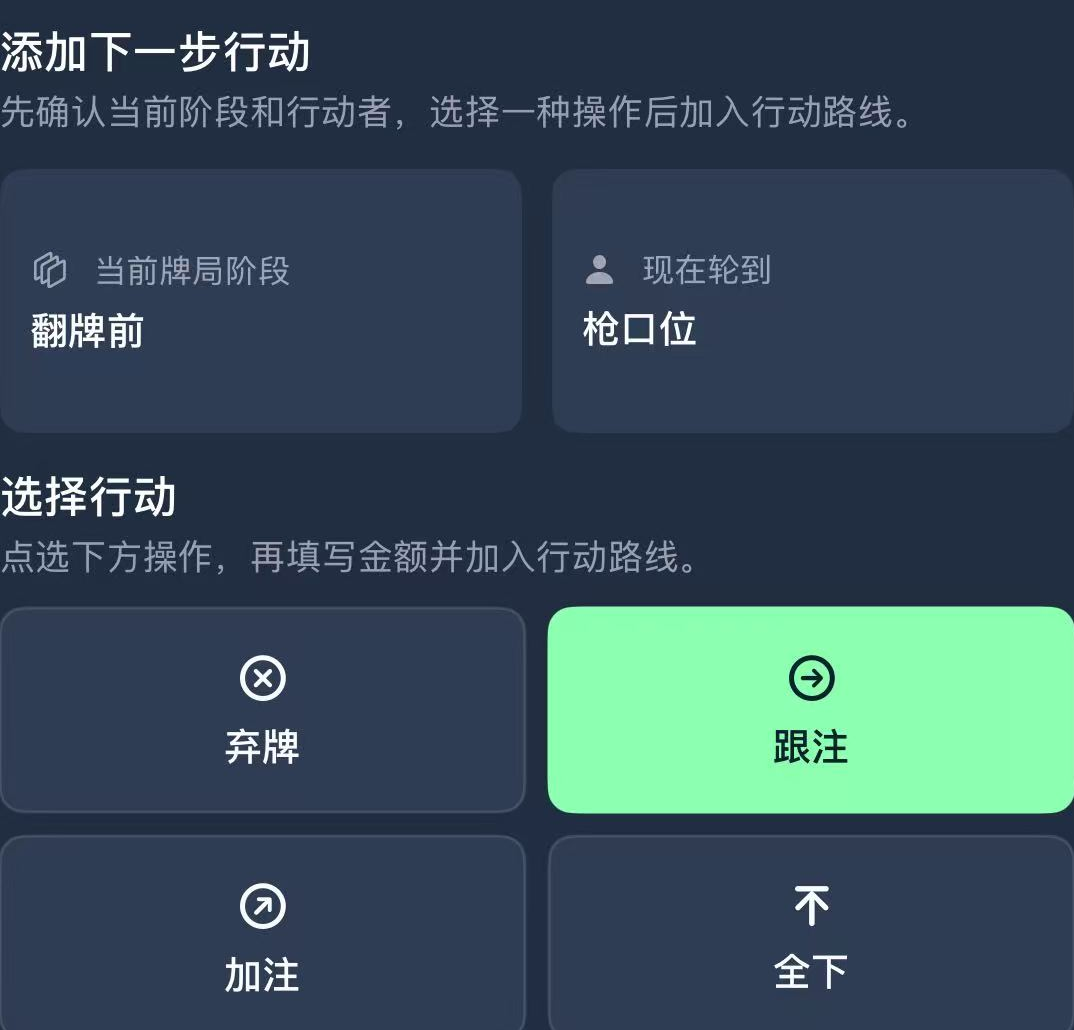
This is range-based reasoning and independently checked pricing, not a solved equilibrium strategy, actual fold-rate estimate or exact hand EV. The pot matches the broadcast. The terminal bluff calculation states its own simplifying assumptions.
Turn the hand into practice
In Master mode, reconstruct only the real history up to the turn raise. Check the pot, amount to call, effective chips and assumed range. Do not enter the future river or treat the revealed KQ as information Tan already had. Use the model to test assumptions, not to replace range analysis.
Hand review questions
Does 98 really have eight winning outs?
No. They are potential straight improvements without conditioning on the opponent. Against KQ they still lose. Unknown-range equity requires weighting legal combinations.
Why distinguish HJ from the button?
Players remain behind Tan preflop, and the flop is three-way. Only after Phua folds does Tan have the last action against Cates alone.
What should a review test first?
List value and semi-bluffs that check-raise and call the reraise; then ask what 98 blocks and which better hands actually fold.
Does adding a history guarantee a better answer?
No. The history must be complete, legal and consistent with the decision; the range assumptions must also be reasonable. An incorrect route, amount or unsupported model can still give an unsuitable output. Runs with different inputs are not a controlled test of history alone.

Turn what you learned into practice.
Review your own completed hands, check equity and pot odds, and practise decisions in Texas GTO Coach.