
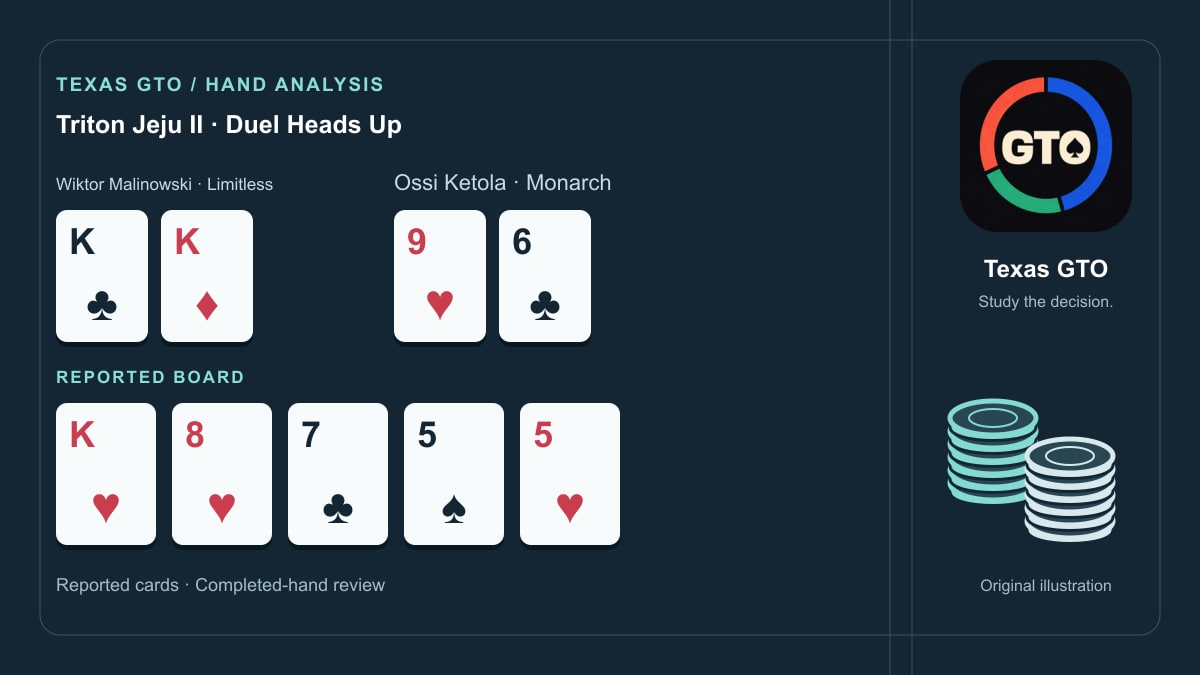
The hand: top set meets a turned straight
REPORTED HAND / VISUAL REPLAY
K♣K♦ top set against the 9♥6♣ straight
Community cards
- 01Preflop$5,000/$10,000 blinds. Malinowski raises to $25,000 on the button; Ketola calls in the big blind.
- 02FlopK♥8♥7♣. Ketola checks; Malinowski bets $15,000; Ketola raises to $50,000; Malinowski calls.
- 03Turn5♠. Check; Malinowski bets $75,000; Ketola raises to $250,000; Malinowski shoves; Ketola calls $580,000 more. Calculated turn total: $830,000 each.
- 04River5♥. Betting is already complete. Malinowski makes kings full of fives and wins the $1,810,000 pot.
The hand was played on September 9, 2026, in the opening Malinowski–Ketola heads-up cash match alongside Triton Jeju II at Les A Casino. The blinds were $5,000/$10,000. In heads-up play, the button is also the small blind and has position after the flop. Malinowski held K♣K♦; Ketola defended the big blind with 9♥6♣.
On K♥8♥7♣, Malinowski has top set and Ketola an open-ended straight draw. The 5♠ completes Ketola's nine-high straight. All the money goes in on the turn, before either player knows the 5♥ will pair the board. The final result is kings full of fives against a straight.
What the first check-raise does to the ranges
The $25,000 preflop investment from each player gives a listed $50,000 pot. Malinowski's $15,000 continuation bet is 30% of that amount. Ketola raises to $50,000, not by another $50,000; calling costs Malinowski $35,000. After the call, the listed pot is $150,000. Tracking totals correctly matters before reasoning about the larger turn decision.
On this connected, two-heart flop, a check-raising range can plausibly contain strong made hands, straight draws and flush draws. Calling with top set can retain weaker hands and keep the button's calling range strong. Reraising would change both the price and the opponent's continuing range. Which choice is better depends on range weights and later play, not simply on having the strongest possible set.
A second check-raise changes the question
The 5♠ is not a neutral card: 96 and 64 can now make straights. Against 96, KK is behind but can improve when the board pairs; against 64, it is also behind on this turn. Some two-pair hands and heart draws could still take an aggressive line, but their presence and frequency are assumptions. The hand shown after the call is only one member of the opponent's possible range.
Malinowski bets $75,000 into the listed $150,000 pot. After Ketola raises to $250,000, a call costs $175,000 and would make a $650,000 pot. That is an immediate price of about 26.9%, before rake or future betting. Shoving instead asks which hands can fold and which will call the much larger investment. The turn straight is an unlikely fold; weaker value and draws can respond differently. Comparing those branches is more useful than treating 'top set' as an automatic stack-off instruction.
Separate matched chips from match buy-ins
Ketola's final $580,000 call comes on top of his $250,000 turn raise, making a turn investment of $830,000. Add $25,000 preflop and $50,000 on the flop: each player has matched $905,000, and the two investments total $1,810,000. This yields a calculated effective stack of 90.5 BB for the hand. The opening $1 million buy-in per player is not its exact starting stack.
With the two actual hands exposed, KK wins on one remaining king, three eights, three sevens or three fives: 10 out of 44 river cards, about 22.7%. This is a simple one-card enumeration, not a solver result or the equity Malinowski could know against an unrevealed range. The river 5♥ makes a full house, which beats Ketola's straight even though a third heart appears. There is no river betting decision because both players are already all-in.
Three questions for your next hand review
First hide the river and the opponent's cards. List the value hands and draws that can raise the flop, then cross out or reweight the ones unlikely to check-raise the 5♠ turn. Does your model include enough weaker value or draws to change the value of raising with KK? Keep that range exercise separate from the revealed-card 22.7% calculation.
Next compare calling the extra $175,000 with shoving, recording both the price and the possible responses. Finally ask which river cards help your own hand but also complete an opponent's draw, and how you would react if chips remained. Save the cards and actions in Texas GTO for post-session study and put the assumed ranges in your notes. The skill to practise is updating a range and comparing branches before seeing the result.
Hand review questions
Was the hand a $2 million pot?
No. Each player bought into the opening match for $1 million, but this particular pot was $1,810,000. The recorded action reconciles to $905,000 matched per player, or 90.5 big blinds. Match buy-ins and one hand's effective stack are different quantities.
How could the turn nuts lose on the river?
Ketola's 9♥6♣ makes 5-6-7-8-9 on the turn. Malinowski can still improve to a full house or four kings when the board pairs. With both holdings revealed, ten of the 44 possible river cards win for KK; the actual 5♥ makes kings full of fives.
Does the winning river justify the turn shove?
No. Evaluate what can check-raise twice, what folds to the shove and what calls. A wider range containing draws and weaker value changes the problem relative to a range dominated by straights. This review compares hypotheses; it is not a solver prescription.