
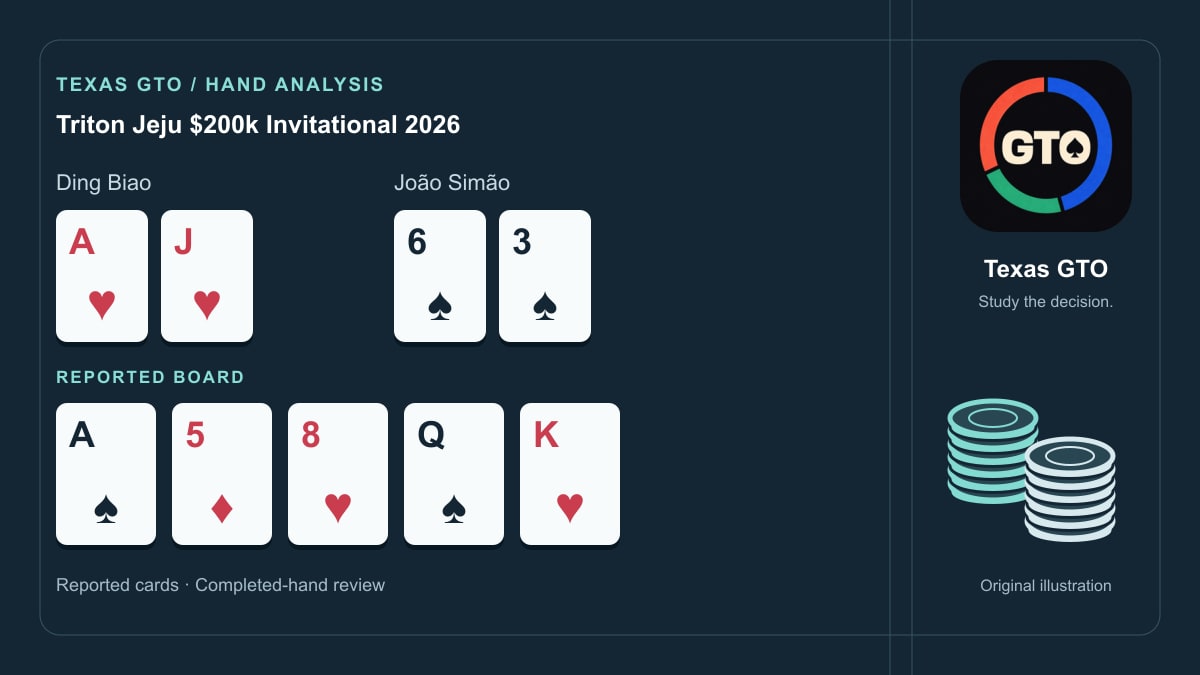
The official heads-up hand, suits included
REPORTED HAND / VISUAL REPLAY
A-J catches the missed spade draw
Community cards
- 01PreflopSimão limped the small blind; Ding raised; Simão called.
- 02FlopDing bet top pair; Simão raised; Ding called.
- 03TurnBoth checked the Q♠ turn.
- 04RiverDing checked; Simão bet 14 BB into 25 BB; Ding called and won the hand.
Triton's September 14 report supplies the suits through its inline card graphics. Ding's A♥J♥ beats Simão's 6♠3♠ on this board. Ding won this pot and took the lead, but Simão subsequently won the tournament. Keeping those outcomes separate prevents a good-looking call from becoming a misleading championship story.
The checked turn still carries information
A flop raise on A-5-8 can contain strong made hands and bluffs with backdoor potential. The Q♠ turn adds a flush draw to the actual 6♠3♠. Checking behind does not prove that the range has given up, nor does it automatically cap it at weak hands. Some strong hands can check; some draws can keep their chance to bluff later.
The river king misses spades but improves other candidates. J-T can make Broadway, and ace-king can make two pair. A-J remains one pair, so the calling decision should compare surviving value combinations with missed draws that actually choose to bet. Listing all missed spades without weighting their earlier actions can exaggerate the bluff count.
The calling threshold is about 26.4%, not a solver verdict
The official 14-BB bet into 25 BB gives a clear price. Calling invests 14 BB to contest a 53-BB final pot: 14 ÷ 53 is approximately 26.4%. Under the simplifying assumption that top pair only wins against bluffs, that is the minimum bluff share required. If the bettor value-bets worse hands or some bluffs beat A-J, the model needs adjustment.
Compare that price with an overbet rather than transferring a dramatic cash-game call unchanged. Different sizes require different bluff frequencies. A favorable price is necessary for a call under a given model; it does not tell you whether the opponent supplies those bluffs.
Heads-up tournament pressure is not three-handed ICM
There is no third short stack whose elimination can create a pay jump. Do not import a three-handed ICM explanation into this heads-up spot. Use the effective stack, remaining prize incentives and the actual betting line; the report leaves the starting depth and early sizes incomplete, so a precise tournament solver reconstruction would be speculative.
For practice, build two 14-BB betting ranges on the same river: one with enough missed-spade bluffs and another weighted toward value. Compare A♥J♥ in each. Then raise the bet size while keeping the range fixed and recompute the threshold. Finish by hiding the tournament result: one correctly read bluff does not guarantee a title, and a later loss does not invalidate this individual review.
Hand review questions
What bluff frequency did Ding need on the river?
If A-J beats every bluff and loses to every value bet, the reported price requires 14 ÷ (25 + 14 + 14), approximately 26.4% bluffs in the betting range. This conditional threshold is not proof that the actual range had enough bluffs.
Why does the Q♠ turn matter even though both players checked?
It gives a two-spade hand a flush draw that can miss on the non-spade river. A checked turn does not erase draws or earlier strong hands. Their river frequencies still depend on the full line.