
The hand: positions and action
REPORTED HAND / VISUAL REPLAY
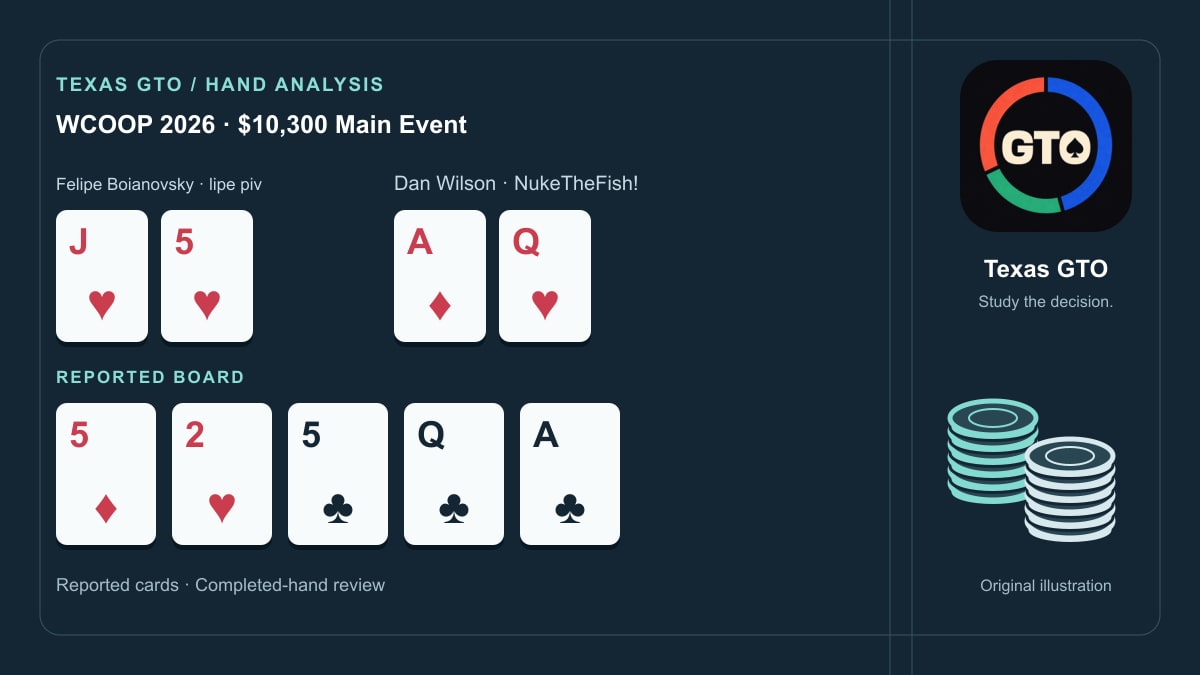
Button pressure: J♥5♥ against offsuit A♦Q♥
Community cards
- 01PreflopSB 200,000; BB 400,000; central forced bets 150,000. BTN shoves 48,691,578 chips; SB calls all-in; BB folds. Unmatched chips return to BTN. Final pot: 20,836,600 chips.
- 02Flop5♦2♥5♣: Boianovsky makes three fives. Wilson is already all-in and all betting is complete; no new decision.
- 03TurnQ♣: Wilson improves to two pair, queens and fives, still behind trips. No betting.
- 04RiverA♣: Wilson has aces and queens; Boianovsky's trip fives win. Wilson is eliminated in third place.
The hand was played on September 30, 2026, at the final table of the PokerStars WCOOP $10,300 Main Event. The September 27–30 tournament drew 289 entries and a $2,890,000 prize pool. The Day 4 replay shows the hand at 03:31:21–03:31:44, with client hand number #262254346199.
Boianovsky is on the button, Wilson in the small blind and Plante in the big blind. Wilson calls with offsuit A♦Q♥; Plante then folds 3♣T♠. When Wilson decides, however, the big blind has yet to act. He must account for an overcall without knowing Plante's cards. The later fold does not make his earlier decision a heads-up problem.
48.7 million shoved is not the effective stack
The blinds are 200,000/400,000, with a further 150,000 in central forced bets. That total is consistent with three 50,000 antes, though individual payments are unavailable. Wilson has approximately 9.9M behind after posting his small blind; Plante has approximately 12.8M behind after posting his big blind. A call is evaluated against the chips the opponent can actually win from Wilson, rather than the covering player's entire announced shove.
Boianovsky announces 48,691,578, but his excess returns after Wilson calls and Plante folds. The contested pot is 20,836,600 tournament chips. Subtracting Plante's big blind and the central forced bets gives (20,836,600 − 400,000 − 150,000) ÷ 2 = 10,143,300 matched chips per player, excluding antes: about 25.36 BB. Wilson's additional call is 9,943,300; 38,548,278 returns to the button. These amounts are calculated from the final pot. That effective depth, not 48.7 million, defines Wilson's risk.
Why a chip leader can apply button pressure
A covering button can win the forced bets without a showdown and can threaten another player's tournament survival without risking immediate elimination himself. J♥5♥ has some equity when called, but a plausible strategic reason to shove is fold pressure, not the expectation of flopping trips. That is a hypothesis about the decision; it does not prove this particular hand belongs in an optimal shoving range.
Wilson's AQ is a strong starting hand, yet the decision is not a heads-up cash-game call. A wide button range makes more weaker hands available; a tighter range changes the assessment. Plante still has a decision behind Wilson, creating possible overcall and three-way outcomes. Do not remove that branch merely because the recorded hand ended heads-up. Likewise, do not supply the players with the broadcast's knowledge of all three hole-card holdings.
How pay jumps affect the AQ call
The official replay lists $551,632.39 for first, $412,913.95 for second and $309,078.85 for third. Moving from third to second adds $103,835.10; first to second differs by $138,718.44. These are dollar prizes, separate from the chip pot. Wilson's elimination secures at least second for Plante. Boianovsky later wins the event, but that later result is not evidence that every earlier shove was correct.
ICM, the independent chip model, translates chip distributions into estimated shares of the remaining prizes under model assumptions. The threat of elimination can make chip gain and prize-money gain differ: winning chips and preserving the chance to reach second place have different effects on prize equity. An exact answer also depends on Plante's starting stack, individual antes and the assumed ranges. Those inputs are incomplete here, so this hand supports a qualitative discussion of pressure, not an exact shove frequency or mandatory AQ fold. Broadcast win percentages against revealed cards are not an ICM calculation.
Review the decision before revealing the board
First hide the flop and label all three seats, who covers whom and the matched depth. Compare two button-range hypotheses, one wider and one narrower. For each, ask what Wilson beats and how Plante continuing would alter the problem. Does the call still look attractive if the button's range is tighter, or if the big blind overcalls? Keep chip-based reasoning separate from prize equity. A precise ICM comparison requires complete tournament inputs; record any unknowns alongside your range assumptions.
Only then reveal 5♦2♥5♣Q♣A♣. The flop gives Boianovsky trips; the turn and river improve Wilson, but his final aces and queens still lose to three fives. There are no postflop bets because the hand was already all-in. Save the cards and action in Texas GTO for post-session study, record assumptions in your notes and compare decisions without using the lucky flop as a verdict.
Hand review questions
Does losing with AQ prove the call was wrong?
No. Assess the button's plausible shoving range, effective stack, player behind and payouts before revealing the board. A♦Q♥ is offsuit; do not substitute suited AQ in a model. This runout alone cannot establish the call's expected value.
Was Wilson risking 48.7 million chips?
No. That was the covering button's announced shove. Unmatched chips were returned. The final pot reconciles to 10,143,300 chips matched per player, excluding the central forced bets, or about 25.36 current big blinds.
Can Texas GTO give an exact ICM answer for this hand?
This hand history alone is insufficient. An exact ICM calculation needs all three starting stacks, the ante structure, plausible ranges and an appropriate tournament model. Texas GTO can help organize the cards, action and range assumptions for post-session review; general training feedback is not an exact ICM solution for this final table.