Hand history
Session: 6 August 2024 · Montenegro · Official report dated 9 August 2024
REPORTED HAND / VISUAL REPLAY
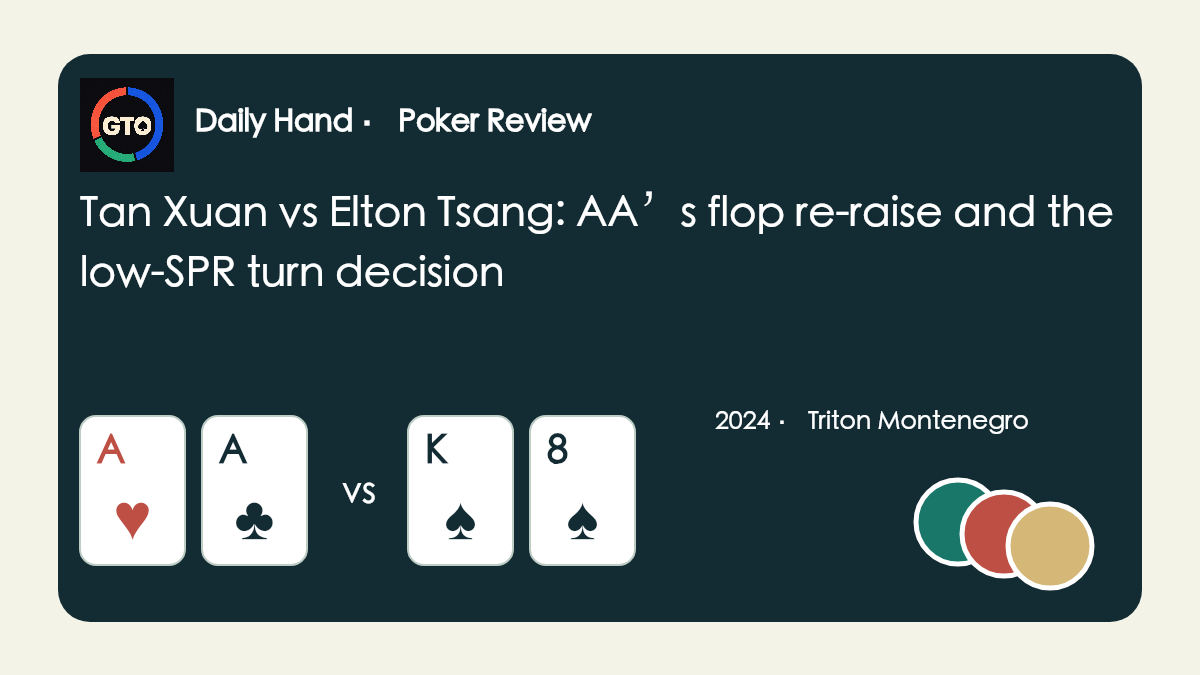
Tan Xuan A♥A♣ vs Elton Tsang K♠8♠
Community cards
- 01PreflopElton opens to 4BB; Tan three-bets to 12.5BB; Elton calls. Pot at street end (BB): 29BB.
- 02Flop3♠ 8♦ 5♥: Elton checks; Tan bets 14BB; Elton raises to 37.5BB; Tan re-raises to 91BB; Elton calls another 53.5BB. Pot at street end (BB): 211BB.
- 03Turn6♦: Elton checks; Tan bets 115BB; Elton shoves to 154.5BB; Tan calls another 39.5BB. Pot at street end (BB): 520BB.
- 04River9♣: both players are already all-in, with no new action. A♥A♣ beats K♠8♠. Pot at street end (BB): 520BB.
Preflop: AA builds value; K8 must realize equity out of position
AA in the CO can three-bet an HJ open primarily for value and to discourage players behind. Calling retains weaker opens, but also offers others a cheaper entry. Concealment is not the only relevant benefit.
K8 suited has strong-hand potential but faces dominated kings and overpairs on eight-high boards. At 258BB, more postflop room can also magnify equity-realization problems out of position. Calling versus folding depends on ranges and sizing; suitedness is not a universal permission to continue.
Flop: a top-pair raise changes who pays
On the low rainbow 3♠8♦5♥ board, Tan bets 14BB into 29BB, about 48.3%. It can earn value from weaker pairs or draws and charge overcards. Both players may still hold sets: an overpair advantage does not guarantee a nut advantage.
Elton has top pair and backdoor spades. Calling preserves more high-card bluffs and controls the pot. Raising to 37.5BB can deny some overcard equity, but continuers often become more concentrated in overpairs, sets and stronger draws. If weaker hands mostly fold, this is not automatically a strong value raise.
Flop re-raise: value versus isolating a stronger range
Tan’s re-raise to 91BB leaves Elton a 53.5BB extra call. It builds value quickly if weaker pairs still continue and can charge draws more. If those weaker hands fold, AA may isolate itself against sets and strong draws.
Calling the 37.5BB raise instead retains some raising bluffs and puts strong overpairs in the calling range, at the cost of less immediate value and more equity realization for draws. The later reveal of K8 does not prove the re-raise optimal. After Elton calls, the pot is 211BB with 154.5BB effective behind: turn SPR is about 0.73.
Turn: connectivity matters even at low SPR
6♦ completes 97, 74 and 42 if those holdings survive the earlier ranges, and gives two-diamond holdings a flush draw. Their actual presence depends on preflop and flop play, not merely on possible hand rankings. A♥A♣ does not block diamond draws and removes some potential ace-high bluffs; those effects point in different directions.
Tan bets 115BB, about 54.5% pot. Low SPR makes an overpair more capable of absorbing commitment, not proof of an optimal size. A smaller bet may retain more weak calls; checking may retain bluffs. Their costs are less immediate value or free river equity. Start with the updated continuing range before organizing the remaining 154.5BB.
Turn shove: count the additional call, not the whole shove
Elton shoves to 154.5BB after Tan has bet 115BB. Tan needs only 39.5BB more. The pot before calling is 480.5BB and afterwards 520BB: 39.5/520 = 7.60%. Past investment does not vindicate an earlier bet, but it does change the price of the current call.
Against the revealed AA, K8 wins on three kings and two eights: five of 44 rivers, or 11.36%, with no ties. The 6♦ killed the backdoor spade draw; one spade river cannot create five spades. This known-hand enumeration is not equity against Tan’s unknown range and does not include fold equity. It cannot alone establish solver EV.
River: an outcome, not another decision
Both players are all-in when 9♣ arrives and AA remains ahead. Return to the earlier questions: which worse hands pay 91BB, which strong hands remain, and what do alternative turn sizes or checks gain and lose? The winning result cannot answer them.
Practice the decision process
Texas GTO Coach offers structured poker training. Revisit positions, ranges and sizing; this article is not a hand-specific solver output or a promise of profit.
Hand review questions
Must AA re-raise on a low flop?
No. Compare weaker payments, strong continuers and retained bluffs. Calling can also protect the calling range.
Why is the call price 7.60%?
Tan already put in 115BB on the turn. He adds 39.5BB to a final pot of 520BB, not the entire 154.5BB shove.
Does K8’s 11.36% settle its shove?
No. It enumerates one river against known AA. Range equity, fold equity and alternative-action EV have not been solved.

Turn what you learned into practice.
Review your own completed hands, check equity and pot odds, and practise decisions in Texas GTO Coach.