Hand history
Session: 6 August 2024 · Montenegro · Official report dated 9 August 2024
REPORTED HAND / VISUAL REPLAY
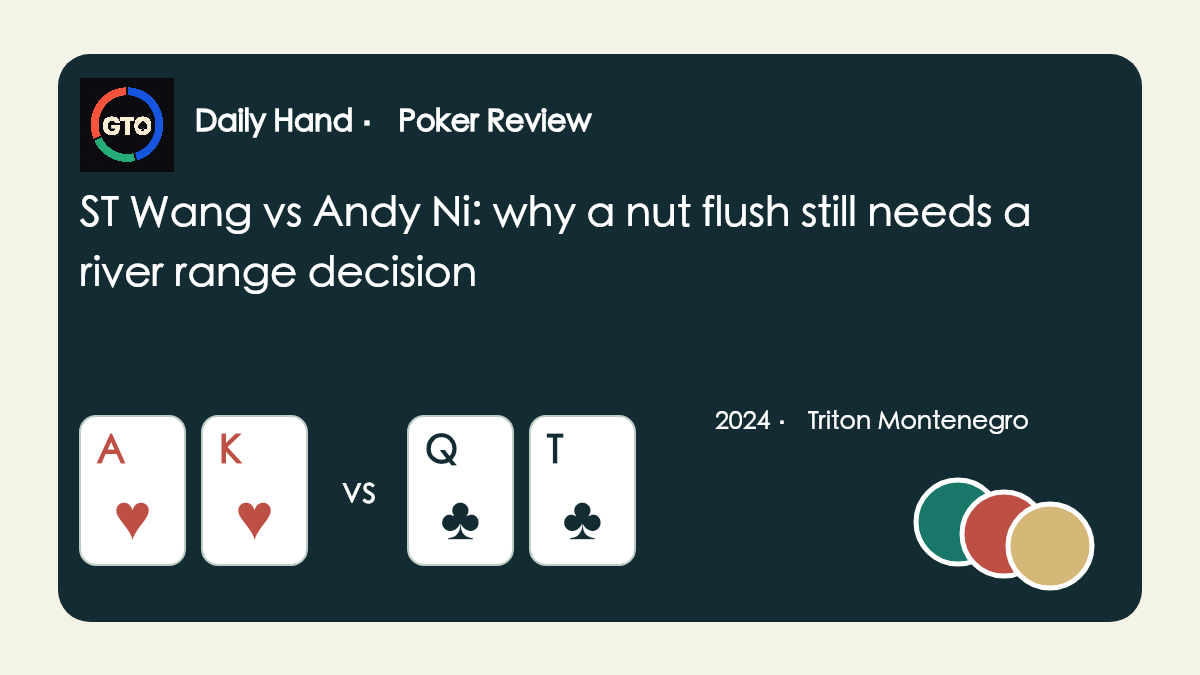
ST Wang (Esti Wang) A♥K♥ vs Andy Ni Q♣T♣
Community cards
- 01PreflopNi opens to 5.5BB; Wang three-bets to 17.5BB; Ni calls. Pot at street end (BB): 41BB.
- 02Flop2♠ J♠ 7♥: Ni checks; Wang checks. Pot at street end (BB): 41BB.
- 03TurnT♥: Ni checks; Wang checks. Pot at street end (BB): 41BB.
- 04RiverJ♥: Ni bets 26BB; Wang raises to 67.5BB; Ni shoves to 223.5BB; Wang calls an additional 156BB. A♥K♥ beats Q♣T♣. Pot at street end (BB): 488BB.
Preflop: value and position, not a short-stack shortcut
AK suited in the HJ can three-bet an UTG+1 opening range for value against weaker aces and suited broadways while discouraging players behind from entering. At 241BB effective, however, the later decision space is substantial: a short-stack “stack off AK” rule is not transferable.
Calling keeps weaker hands in and limits the immediate investment, but invites a cheaper multiway pot where high-card equity can be harder to realize. Ni’s open-call range can still contain medium and high pairs and suited broadways. Their frequencies are unknown; it must not be retroactively reduced to QT.
Flop: checking realizes equity without automatically surrendering
On 2♠J♠7♥, AK has two overcards and backdoor hearts, not a direct flush draw. A bet can fold some weak hands and charge continuing equity. Yet Ni may retain JJ, 77 and other calls or raises: preflop initiative is not ownership of every nut combination.
Checking back uses position to see a turn and keeps Wang’s checking range from consisting only of give-ups. If betting instead, plan which hands continue against a raise. “Protect AK” alone does not justify every size.
Turn: a nut-flush draw does not mandate a bet
T♥ supplies the nut-flush draw but also improves possible TT and JT in Ni’s range. Betting can pressure weaker draws or one-pair holdings. A deep check-raise, however, may force AK to pay heavily before the flush is complete.
Checking preserves the pot and a free river; its cost is giving up some equity denial. Two checks do not prove Ni lacks sets, nor do they prove Wang cannot hold strong hands on the river. Neither range should be casually capped.
River raise: the nut flush is not the overall nuts
J♥ both completes hearts and pairs the board. AK loses to JJ quads and TT, 77 or 22 full houses. JT, J7 or J2 also make boats if those hands survive the earlier ranges; their presence is conditional, not an asserted frequency.
After Ni bets 26BB, raising to 67.5BB needs worse hands to pay, such as lower flushes that still call. Calling instead retains bluffs and weaker value bets. If lower flushes mostly fold while Ni’s continuing range is strong, the raise loses value. Winning the showdown does not settle that comparison.
Facing the shove: separate price, blockers and range
Ni shoves to 223.5BB on the river. Wang has already paid 67.5BB, so the extra call is 156BB into a final pot of 488BB: 31.97%. This is an equity price, not a required hand-defense frequency. Only if AK loses to all value and beats all bluffs can it translate into the simplified required bluff fraction. Overplayed weaker flushes need a separate category.
A♥K♥ removes some worse flushes that might pay and some potential flush bluffs, but does not remove boats without aces or kings. Ni’s T♣ reduces TT and JT; having no heart leaves many flush calls available to Wang. Blockers work in several directions. QT was revealed only at showdown, not known during Wang’s decision.
Practice the decision process
Texas GTO Coach offers structured poker training. Revisit positions, ranges and sizing; this article is not a hand-specific solver output or a promise of profit.
Hand review questions
Does 31.97% prove Wang must call?
No. The price sets an equity threshold; the shove’s value, bluffs and overplayed weaker hands still determine the decision.
Do two checks rule out a full house?
No. Sets can trap, and turn-improved two pair can check. Their actual frequencies require additional range evidence.
What should a recreational player practice?
Name the worse hands that pay a raise, compare calling, then examine blockers and price. Do not treat “nut flush” as “unfoldable”.

Turn what you learned into practice.
Review your own completed hands, check equity and pot odds, and practise decisions in Texas GTO Coach.