Hand history
Played: 17 October 2026 · Las Vegas · PGT report: 17 October 2026
REPORTED HAND / VISUAL REPLAY
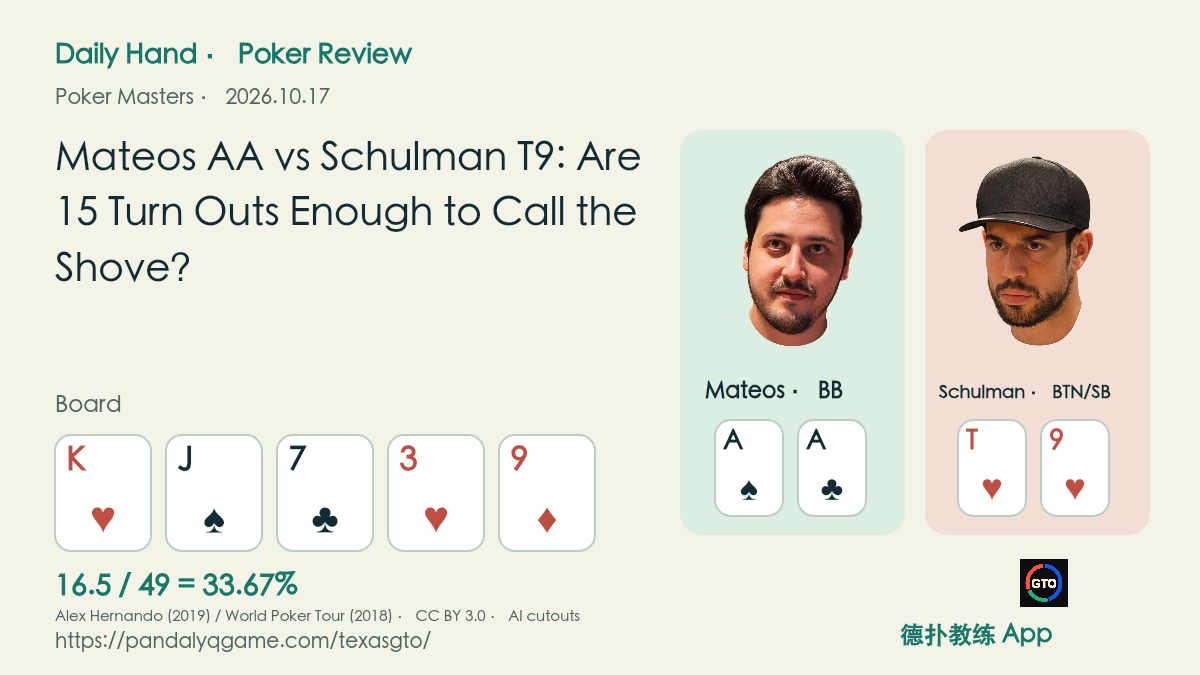
Mateos A♠A♣ vs Schulman T♥9♥
Community cards
- 01PreflopSchulman limps the button/small blind to 1BB; Mateos raises the big blind to 3.5BB; Schulman adds 2.5BB. Including the 1BB ante, the pot is 8BB.
- 02FlopK♥J♠7♣: Mateos bets 4BB; Schulman calls. Pot 16BB, with Schulman holding 16.5BB behind.
- 03Turn3♥: Mateos bets Schulman’s remaining 16.5BB; Schulman calls. Final pot 49BB.
- 04River9♦: both players are already all-in. Schulman pairs his nine, but AA wins.
Preflop: position helps a suited connector, but price still matters
At roughly 24BB effective, a button limping strategy can contain strong hands, playable hands and weaker holdings. A limp does not establish weakness. T♥9♥ has connectivity and position, but must add 2.5BB against the raise to 3.5BB and face the big blind’s stronger raising range. Suitability alone is not a justification for every call.
Opening with a raise is a reasonable alternative: it gains initiative but may face a reraise or shove. With AA, Mateos can build value against weaker continuing hands and charge them to realize equity. Checking to trap keeps a wider range involved while giving many hands a free improvement. Without complete preflop ranges, neither line comes with a proven unique frequency.
Flop: eight straight outs do not buy two free cards
On K♥J♠7♣, a queen makes T9 a king-high straight and an eight makes a jack-high straight. This is a double-gutshot; hearts are only a backdoor flush draw at this point. Facing half pot, Schulman’s immediate price is 4/16, or 25%. That pays for this call, not a guarantee of seeing both remaining cards.
The isolating range can contain AA and AK, while the limp-calling range can retain KJ, 77 and draws. Neither player automatically owns every nut combination. AA can bet for value against Kx, some Jx and draws; checking can retain weak hands and strengthen the checking range. Calling T9 preserves position and turn options. Raising needs sufficient fold equity to compensate for the strength of the range that continues.
Turn: a new draw changes the incentives, not the current leader
The 3♥ adds a flush draw without moving T♥9♥ ahead of AA. Effective chips behind are 16.5BB into 16BB, an SPR of about 1.03. Mateos bets enough to cover Schulman, about 103% pot. The sizing seeks calls from worse hands willing to continue and charges draws almost a pot-sized price for the final card.
Checking can allow free improvements but may induce bluffs. A smaller bet retains more weak calls while giving draws a cheaper price. A♠A♣ does not remove heart draws, yet that alone cannot establish that shoving beats checking. Compare how plausible Kx, Jx, two pair, sets and semibluffs respond to each line rather than treating a low SPR as an instruction.
Price and clean outs: a very narrow conditional margin
Schulman must add 16.5BB to reach a final pot of 16 + 16.5 + 16.5 = 49BB. The chip-equity threshold is about 33.67%. Against the revealed A♠A♣ alone, there are nine hearts, four queens and four eights, with Q♥ and 8♥ counted twice. That leaves 15 winning rivers among 44 unseen cards: about 34.09%.
The gap is only about 0.42 percentage points, and the latter figure is conditional on this exact AA. Against AT, some queens make the opponent a higher straight. Against stronger heart draws, some flush outs can be dirty. Pairing a nine or ten does not beat AA. Treat the strong draw as a candidate to continue, then weight its equity against the entire betting range instead of using one showdown to prove that range.
River and review: the result does not invalidate the calculation
The 9♦ gives Schulman one pair, still behind AA. All decisions ended on the turn; the river is a runout, not another betting node. Heads-up also differs from a multiway bubble, so a blanket survival argument is not enough. This analysis does not calculate tournament utility, future skill edge or series-point value.
Hide Mateos’ cards first. Separate plausible value hands, strong draws and weaker bluffs, then ask how T♥9♥ performs against each group. Next replace the turn bet with half pot and revisit both the price and the betting range. Changing only the denominator while keeping an unjustified range is not a useful model.
Practice range and sizing decisions
Texas GTO Coach provides structured poker training. Review positions, ranges and bet sizes, then compare your reasoning. This article contains no hand-specific solver output.
Historical portraits: Mateos (2019), Alex Hernando; Schulman (2018), World Poker Tour. Both CC BY 3.0, via Wikimedia Commons. Backgrounds removed with AI assistance; not images of this hand. No player endorsement implied. Mateos · Alex Hernando · 2019 · Schulman · World Poker Tour · 2018 · CC BY 3.0


Hand review questions
Why is 17 outs incorrect?
The nine hearts overlap with the queens and eights. Q♥ and 8♥ must each be counted only once, leaving 15 against the known AA.
Is 33.67% a required defense frequency?
No. It is the showdown-equity threshold for this call, not a defense frequency or MDF.
Does the hand prove a mandatory GTO call?
No. The narrow conditional comparison assumes the revealed AA and reported sizing. Unknown ranges require weighting; no solver was run for this hand.

Turn what you learned into practice.
Review your own completed hands, check equity and pot odds, and practise decisions in Texas GTO Coach.