Context and effective depth
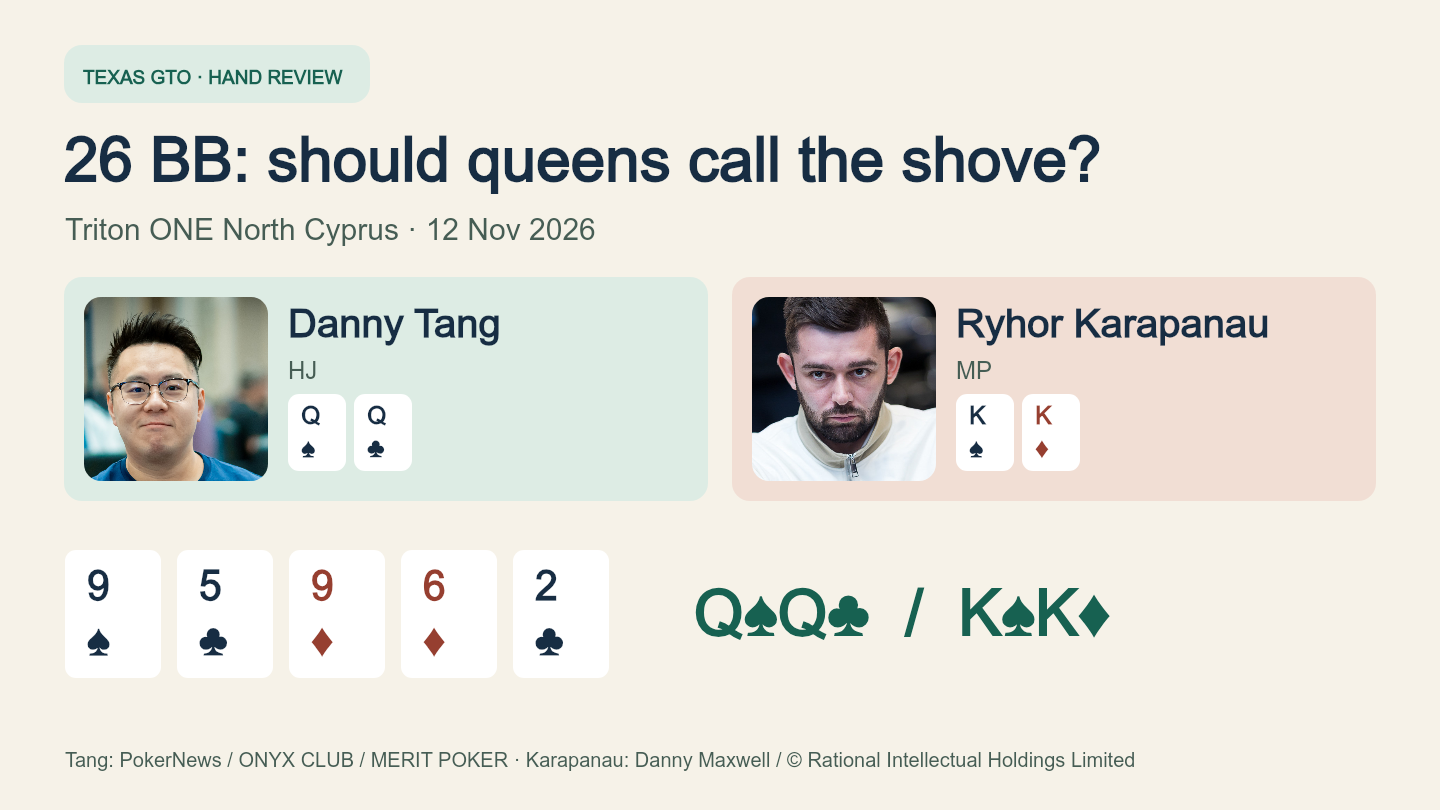
Frank Visser reported this hand from Day 1c of the Triton ONE North Cyprus Main Event on November 12, 2026. Level 9 had blinds of 4,000/8,000 and an 8,000 big-blind ante. All subsequent amounts use big blinds, abbreviated BB. Forced contributions create a 2.5 BB pot.
Danny Tang is in the hijack and Ryhor Karapanau is in middle position, abbreviated MP. Tang commits 209,000 chips in total, equivalent to 26.125 BB. Karapanau covers him. The ledger includes only the matched part of that shove because the report does not state the covering player’s full announced amount.
Action-by-action pot ledger
REPORTED HAND / VISUAL REPLAY
Danny Tang Q♠Q♣ / Ryhor Karapanau K♠K♦
Community cards
- 01ForcedSB posts 0.5 · +0.5 BB · 0 → 0.5 BB
- 02ForcedBB posts 1 · +1 BB · 0.5 → 1.5 BB
- 03ForcedBB ante 1 · +1 BB · 1.5 → 2.5 BB
- 04PreflopMP opens to 2 · +2 BB · 2.5 → 4.5 BB
- 05PreflopHJ three-bets to 6.25 · +6.25 BB · 4.5 → 10.75 BB
- 06PreflopOther players fold · +0 BB · 10.75 → 10.75 BB
- 07PreflopMP shoves to 26.125 effective · +24.125 BB · 10.75 → 34.875 BB
- 08PreflopHJ calls 19.875 · +19.875 BB · 34.875 → 54.75 BB
First decision: three-betting queens
Karapanau opens to 2 BB and Tang three-bets to 6.25 BB from the hijack. Tang adds the full 6.25 BB, taking the pot from 4.5 to 10.75 BB. Queens can seek value from lower pairs and some AK or AQ holdings while denying players behind an inexpensive entry. The actual continuing hands depend on the opener’s range and response.
Flat-calling retains weaker hands but offers players behind a chance to enter and can produce a multiway pot. A smaller three-bet gives MP a better price. Shoving all 26.125 BB removes later decisions but can fold out weaker hands that might otherwise pay. Comparing these alternatives requires ranges; the strength of queens alone does not establish equilibrium frequencies.
Second decision: a 36.3% calling threshold
The remaining players fold and Karapanau shoves. The matched total is 26.125 BB. Having already invested 2 BB, he adds 24.125 BB, growing the pot from 10.75 to 34.875 BB. Tang has paid 6.25 BB and must add 19.875 BB. A call creates a 54.75 BB final pot, so break-even equity is 19.875/54.75, about 36.3%.
At this decision, folding has zero incremental EV and calling has EV = equity × 54.75 − 19.875 BB. Earlier chips are already in the pot. Do not subtract the three-bet again or confuse the opponent’s total shove with the additional call. Facing the effective all-in leaves call and fold as the available responses.
From one revealed hand to a range
Fixing the exposed Q♠Q♣ against K♠K♦ and enumerating all 1,712,304 five-card boards gives queens about 18.07% equity, including split pots. At this price that means approximately −9.98 BB in calling EV. It is a known-hand comparison; Tang could not see kings when deciding.
For sensitivity examples with equal weights per legal combination, queens have about 18.3% against KK+, 40.1% against QQ+ and AK, and 47.4% after adding JJ. Each independent simulation uses 500,000 samples, with a conservative 95% error bound of roughly 0.14 percentage points. These are declared scenarios, not a measured Karapanau range or an equilibrium solution.
Queens remove some AQ, KQ and QQ combinations but do not block aces, kings or AK. Less AK in the shove lowers the appeal of calling; smaller pairs or extra bluffs improve it. The relevant evidence concerns range composition and weights, rather than the one holding exposed at showdown.
Master Mode action analysis
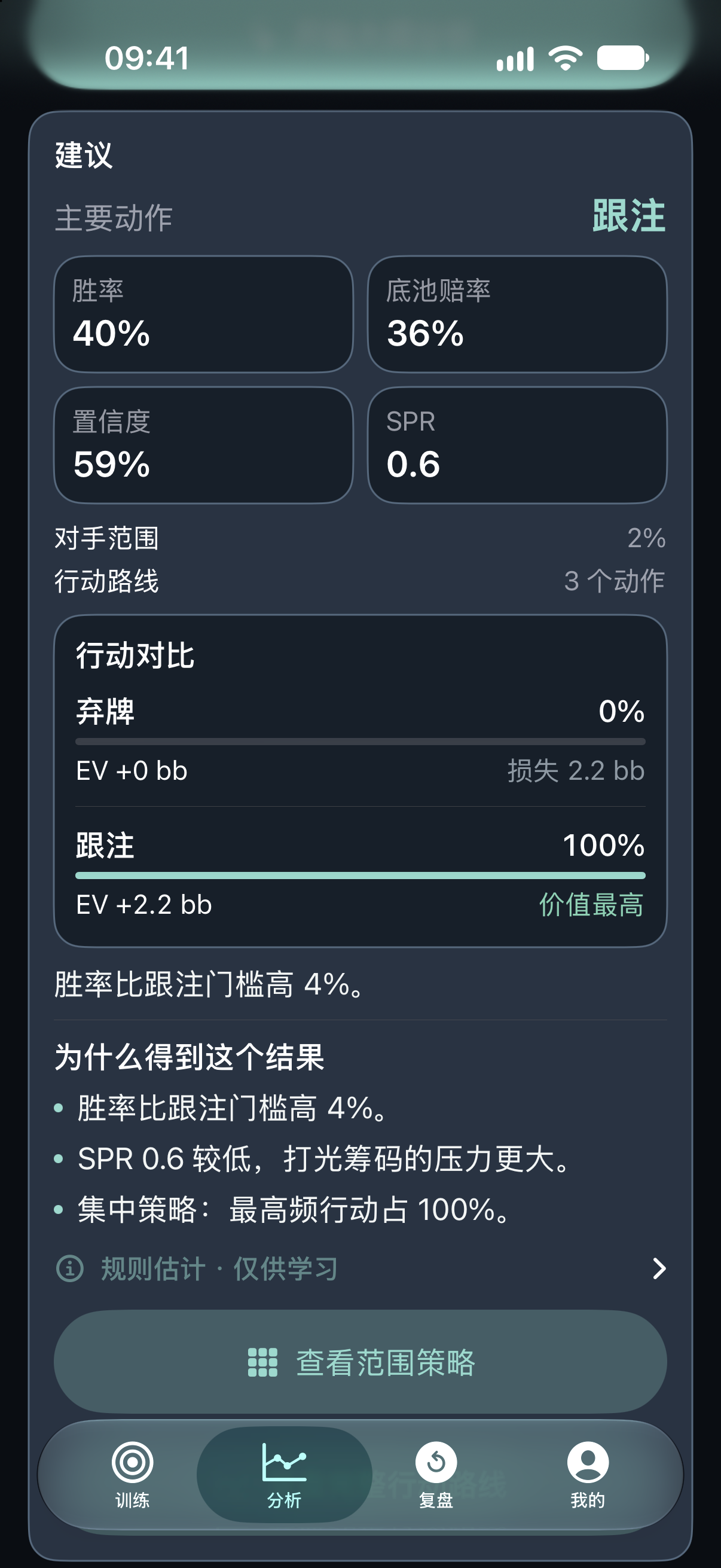
The iPhone simulator runs HJ Q♠Q♣ facing MP’s preflop all-in, with a 34.875 BB pot, 19.875 BB to call and 19.875 BB effective behind. The manually chosen starting range is QQ+ and AK, with all five classes at 100%, before the imported action line updates their weights. This is a review scenario, not an observed opponent range. Neither K♠K♦ nor the subsequent board is entered. A nine-handed model approximates positions, with zero rake. The screen shows about 40% equity, call 100% with EV +2.2 BB, fold 0% with EV 0 BB and roughly 2% range coverage. These are rule estimates under the selected assumptions; the displayed 100% is a recommended action frequency rather than a verified equilibrium solution.
The board records the outcome
The board runs 9♠5♣9♦, 6♦, 2♣. Both players were all-in preflop, so none of these streets contains another betting decision. Karapanau’s kings and nines beat Tang’s queens and nines, eliminating Tang. That outcome does not alter the 36.3% threshold that applied before the cards were dealt.
A useful review exercise
Keep the pot and price fixed while comparing KK+, QQ+ with AK, and ranges containing smaller pairs or bluffs. Change one input at a time. This review concerns chip EV. Complete payouts, field stacks and risk-premium inputs were unavailable, so it does not establish a precise ICM recommendation.
Reporting and portrait sources
Tang: PokerNews / ONYX CLUB / MERIT POKER · Karapanau: Danny Maxwell / © Rational Intellectual Holdings Limited
Hand review questions
Does seeing kings prove queens should fold?
Against those exact kings, equity is below the price. The actual decision concerns an unrevealed range, which cannot be replaced retrospectively with the one exposed hand.
Does a 100% call mean queens must always call?
It describes the screen’s assumed range and price. A tighter range or tournament risk premium can change the decision. Action frequency and the 36.3% price threshold are different quantities.
Turn what you learned into practice.
Review your own completed hands, check equity and pot odds, and practise decisions in Texas GTO Coach.